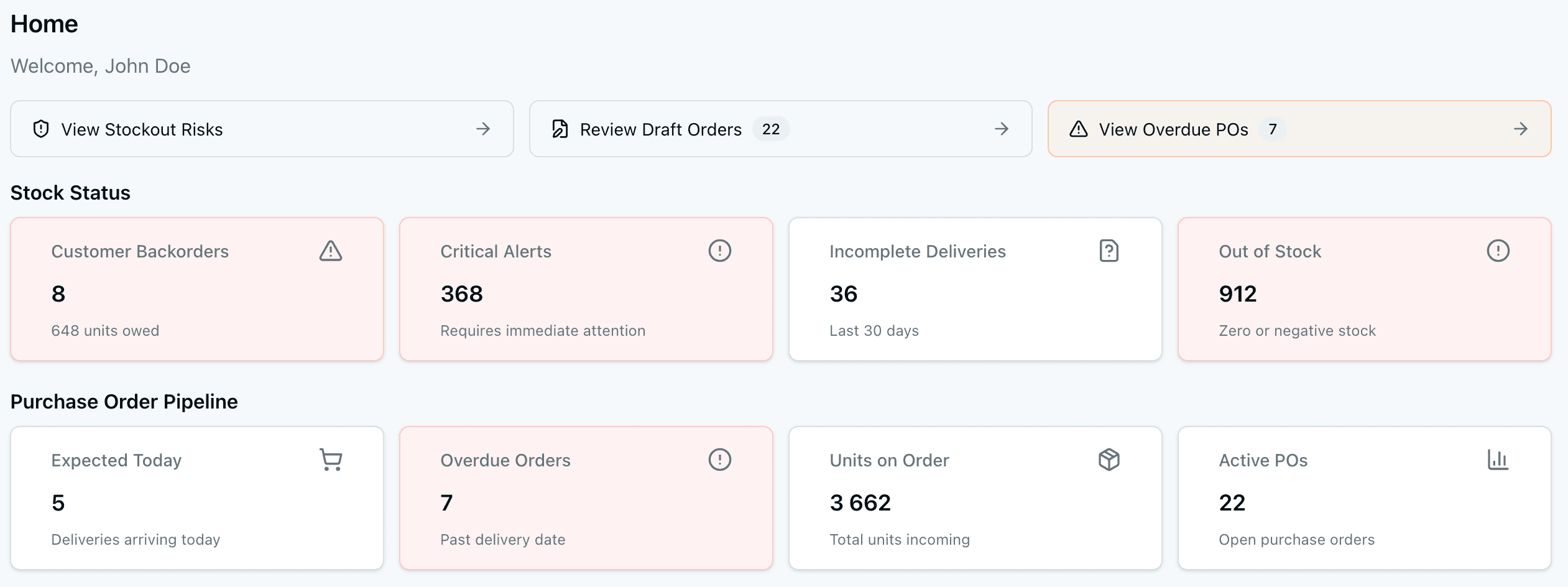
Measured at a Dutch specialty merchant in production since March
~55%
fewer stockouts than the same months a year earlier
285
stockouts caught in time to reorder
~60 days
average warning before a product would run out
The problem
A purchasing Monday, without Voorcast
Most small teams buy the way this reads. It works, until the week it does not.
- 1
Export and squint
Sales go into a spreadsheet. Someone scrolls for what looks low.
- 2
Guess the quantities
Order what you ordered last time, maybe a bit more. Seasonality lives in one person’s head.
- 3
Miss the cut-off
The supplier needed the order on Friday, or the minimum was not met, so it waits another week.
- 4
Sold out and overstocked
The bestseller runs out while cash sits in slow stock that was reordered out of habit.
Why it goes wrong
What a gut-feel reorder misses
A good buyer knows their range. What they cannot do by hand is weigh all of this, for every product, every week.
A reorder from memory and a spreadsheet
- Last month’s sales, not the season ahead
- The lead time the supplier quotes
- Minimums and pack sizes checked afterwards
- Slow sellers reordered out of habit
- Cash in stock nobody sees until year end
A Voorcast draft
- Demand forecast with the season built in
- The lead time the supplier actually delivers in
- Minimums and pack sizes applied before you see it
- Slow sellers flagged for a keep-or-drop decision
- How much cash each product ties up, and for how long
How it works
Voorcast drafts the orders. You approve them.
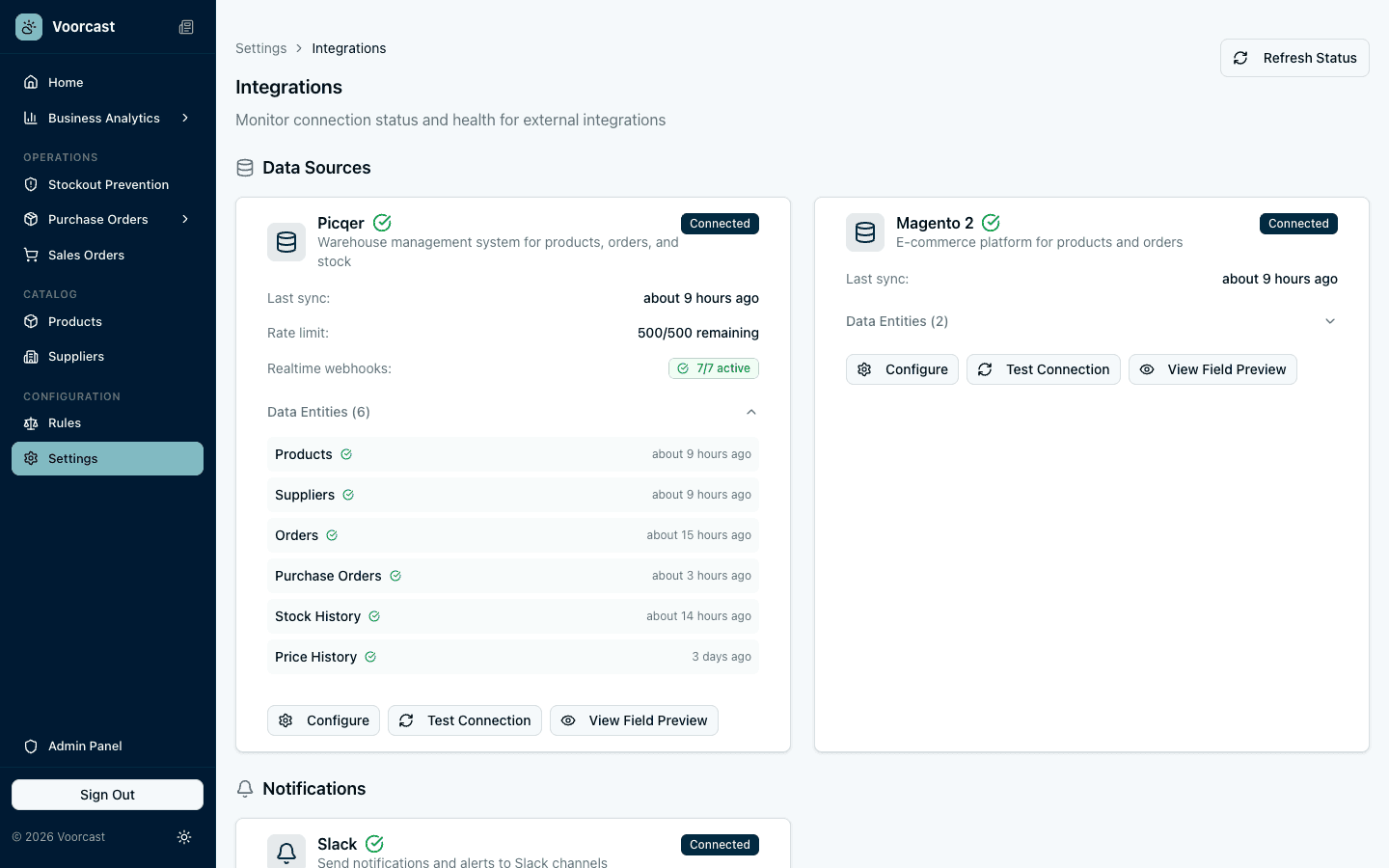
Connect your store
Connect Picqer, and Magento if you sell there too. Products, stock, suppliers and your full sales history come in, and Picqer keeps them up to date.
- Live updates from Picqer
- Your full order history
- Suppliers and their lead times
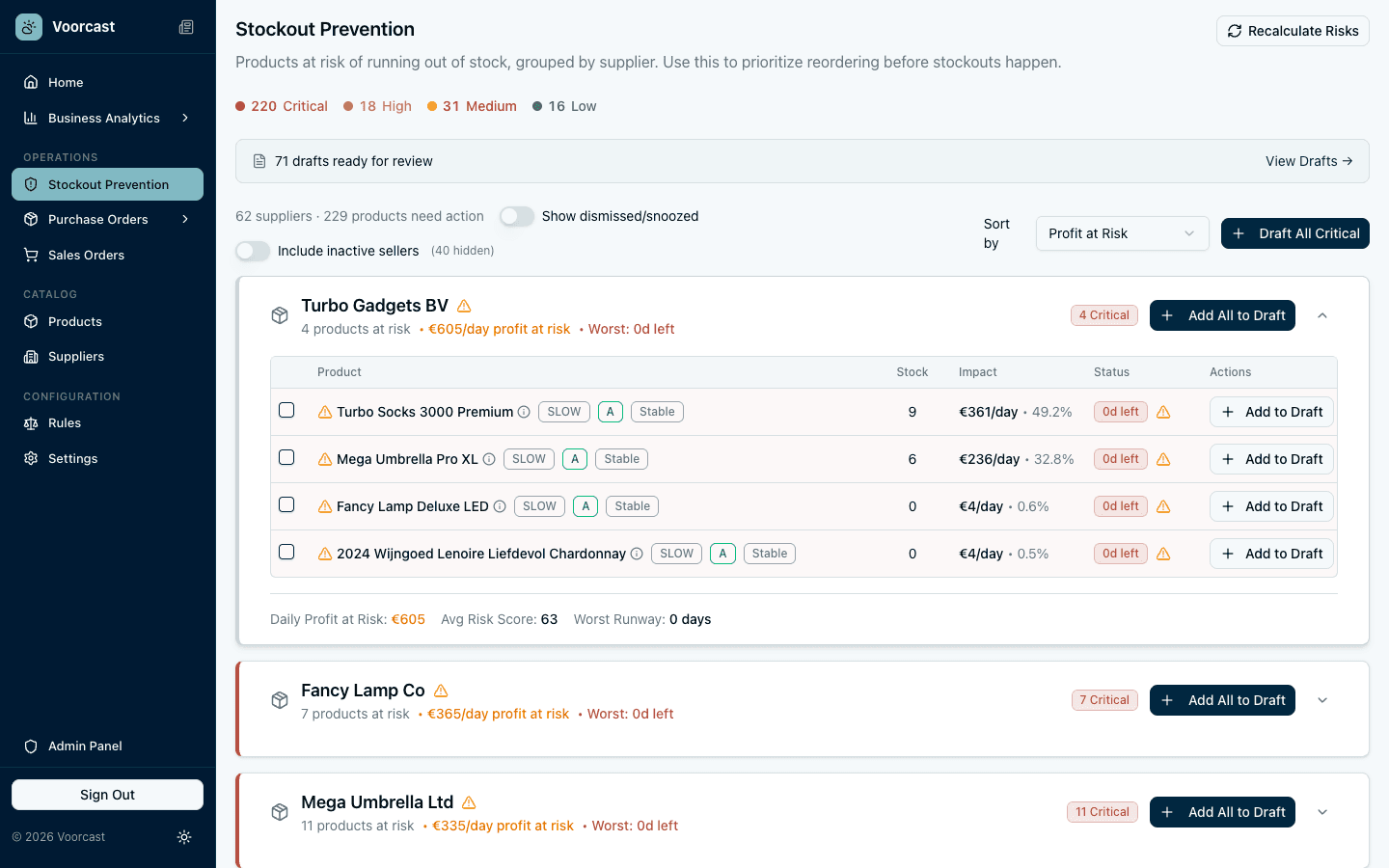
Voorcast drafts the orders
Every night Voorcast checks each product against its forecast and its supplier’s real delivery time, and drafts one order per supplier for what needs buying.
- One draft per supplier
- Quantities sized to the forecast
- The most urgent drafts first
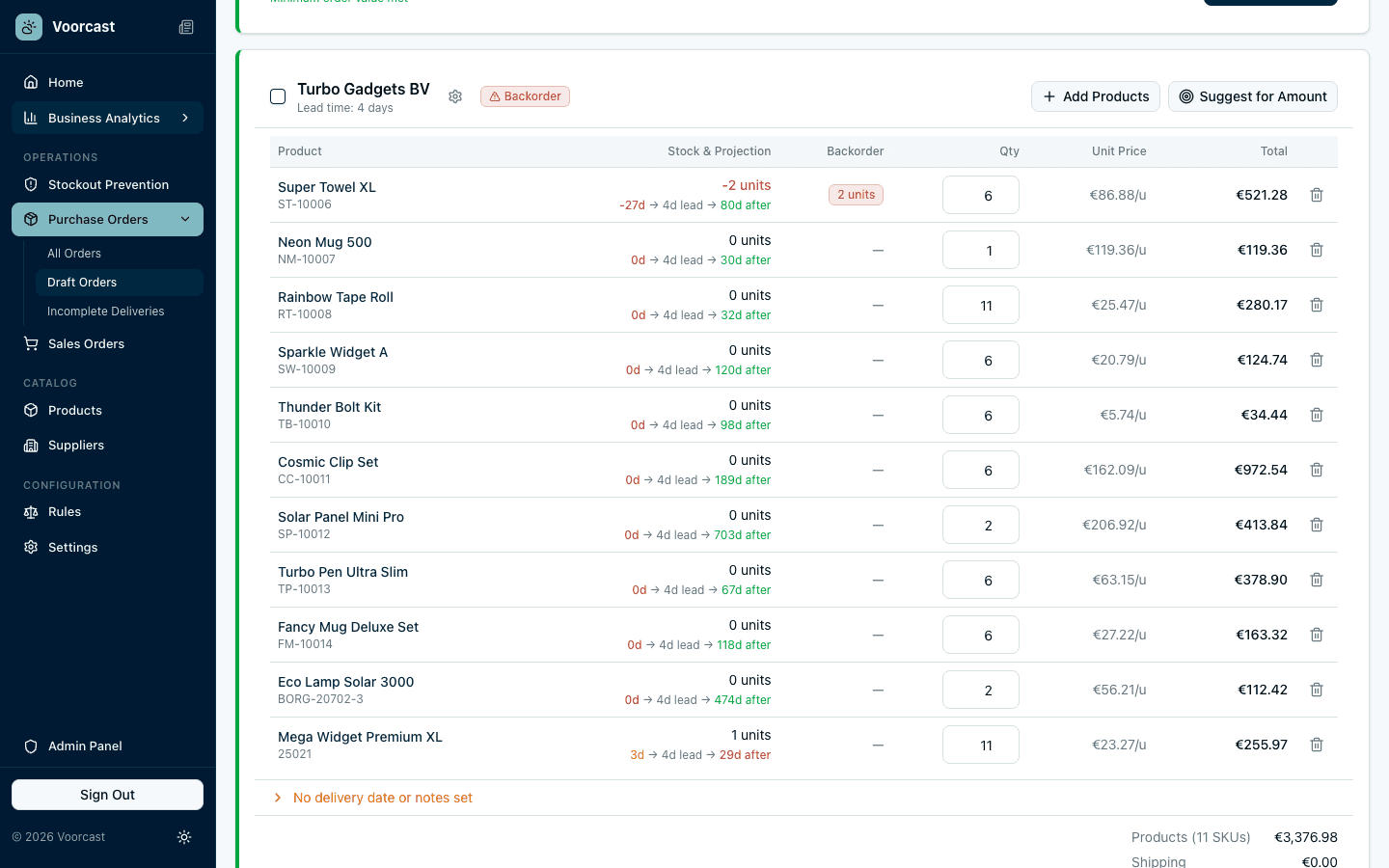
You review and approve
Open a draft, change what you like and send it. It becomes a purchase order in Picqer. Nothing is ordered without you.
- Edit any quantity or product
- Minimums and pack sizes already applied
- Sent to Picqer as a purchase order
It learns from your edits
When you change a quantity or drop a product, Voorcast notes it against that supplier, so the next draft comes closer to what you would have ordered.
- Your edits remembered per supplier
- Lead times re-learned from deliveries
- Thresholds recomputed from your own data
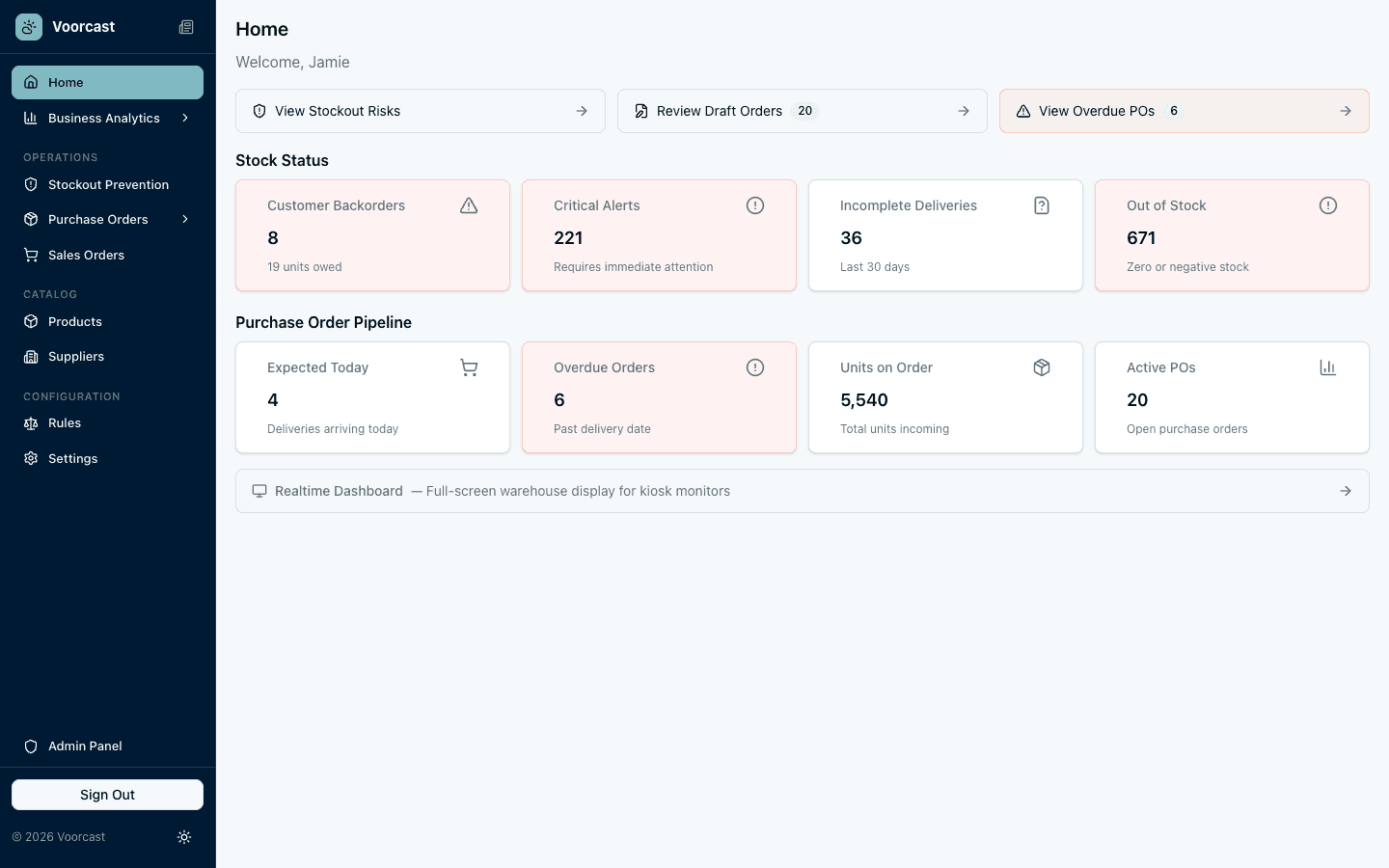
Platform
How Voorcast helps
One platform to manage demand, stock, costs, suppliers, and purchasing.
Demand Forecasting
See how much of each product you'll sell in the coming weeks, seasonal peaks included, and how sure Voorcast is.
Stockout Prevention
Continuous risk monitoring against demand forecasts and lead times. Get alerts before you run out and act instantly.
Cost & Profitability
See true margins after purchase cost, shipping, payment fees, and commissions. Know where your money goes per order.
Supplier reliability
Track supplier lead times, fill rates, and delivery performance. Make purchasing decisions backed by real data.
Smart Reordering
One cart per supplier, automatically filled with recommended reorders. Backorders always included. Review, adjust, and send.
Product Lifecycle
Track products from phase-in to phase-out. Suppress unnecessary alerts for discontinued items and detect dead stock early.
Self-calibrating
It learns what normal looks like in your shop
Voorcast reads percentiles from your own data. As your catalogue, suppliers, and seasons change, the engine recalibrates itself. You don't manage the model. You act on what it surfaces.
What other tools ask you to set up
- Dead-stock cutoff (e.g. 90 days)
- Stockout alert thresholds per SKU
- A best-sellers list to maintain
- Forecast confidence cutoffs
- Global minimum/maximum order quantities
- Manual seasonality flags
What Voorcast figures out from your data
- Dead-stock thresholds from your catalogue's distribution
- Per-SKU risk scored against your own demand history
- Best-sellers recomputed continuously, never flagged by hand
- Confidence scores derived from your forecast quality
- Order quantities derived from supplier behaviour
- Seasonality decomposed automatically from sales data
Built for merchants where global defaults are wrong: slow-rotation specialty, long-tail catalogues, mixed-velocity inventory. Voorcast adapts to your truth, not someone else's.
Who It's For
Built for teams that manage inventory
Whether you own the shop, buy part-time, run purchasing, or run operations, Voorcast fits your workflow.
Owners who do the buying
Over-ordering ties up working capital that should be turning over, and stockouts cost real margin. Voorcast shows you both, product by product, and drafts the order for you to approve.
Part-time purchasers
Buying is one of several jobs on your desk. Voorcast drafts each supplier's order and flags what changed, so you review instead of building spreadsheets.
Purchasing Managers
Stop building spreadsheets to track what to order. Voorcast gives you demand-based suggestions, supplier-grouped risk views, and auto-filled supplier carts.
Operations Directors
See inventory health, dead stock, and supplier performance from a single dashboard. Know where capital is tied up and where sales are at risk.
Frequently asked questions
Is this only for Picqer and Magento merchants?
Today, yes. Picqer and Magento 2 are the supported integrations. Slack is the third for alerts. More on the roadmap.
How long until I see useful output?
Hours, not weeks. The engine learns continuously as it ingests your historical data; first recommendations land after the initial sync completes.
Do I have to configure anything to get accurate forecasts?
No. Voorcast derives thresholds from your data. There are no service-level dials, no demand-class settings, no per-SKU tuning.
How do I know whether to trust a suggestion?
Every forecast shows how much sales history stands behind it, from Insufficient (under four weeks) to Mature (two full years). When a product sells too rarely to forecast well, Voorcast says so rather than guessing.
What about products that only sell a few times a year?
Each product is judged against how your own catalogue sells, so a slow seller is not called dead stock just for being slow, and a fast mover is not left to run out.
I only use Magento. How do I send the purchase order?
Voorcast sends purchase orders through Picqer. Magento gives Voorcast your products and sales; to send an order from Voorcast you also need Picqer.
Who is Voorcast not for?
Warehouses with no stock system in place yet, and pure dropshipping, where you never hold the stock yourself.
What about supplier-specific MOQs, multiples, and contracts?
Lifted directly from Picqer/Magento and respected automatically. We never recommend a quantity that breaks a supplier minimum.
Does Voorcast replace my procurement team?
No. It makes their decisions higher-leverage. The roadmap goes "advise → draft → act under guardrails"; today it is advise + draft, with humans approving every PO.
You approve every order
Nothing is sent without you.
Hosted in the EU
Application and backups in Germany.
GDPR and a DPA
Our Article 28 agreement is public.
Stop ordering on gut feel.
Join the merchants building smarter inventory operations on top of Picqer and Magento.
Request Early Access